Every guy wants a clean fade. But not every fade works the same way. Walk into any barbershop and you’ll hear these two terms more than anything else — low fade and mid fade. Most guys just point at a photo and hope for the best.
That’s the wrong way to do it. Understanding the difference means you get the right fade every single time. This guide breaks it down simply so you can walk in confident and walk out clean.
What Is a Low Fade?

A low fade starts just above the ear and the neckline. The hair tapers down gradually in a very narrow strip around the sides and back. Most of the length on the sides is kept. Only the very bottom fades into the skin.
It’s a subtle, clean look. The contrast between the top and sides is low. That’s exactly where it gets its name.
Low fades work well with longer hairstyles on top. The extra length on the sides balances out longer hair without making it look too heavy or wide.
Key features of a low fade:
- Starts just above the ear
- Subtle, gradual taper
- More hair kept on the sides
- Clean but not dramatic
- Works well with longer tops
Exude timeless wealth with precisely compared side blended styles reflecting elite heritage charm.
What Is a Mid Fade?

A mid fade starts around the temple — roughly halfway up the sides of the head. It creates more contrast than a low fade. The line between the longer top and the faded sides is more visible and more defined.
It’s one of the most popular fades right now. It hits a sweet spot between the subtle low fade and the bold high fade. Not too conservative. Not too dramatic.
Mid fades pair well with almost any haircut on top — crew cut, quiff, textured crop, or even a longer styled look.
Key features of a mid fade:
- Starts at the temple area
- Medium contrast between top and sides
- Versatile — suits most hairstyle lengths
- Clean, modern appearance
- Most popular fade style today
Low Fade vs Mid Fade: Side-by-Side Comparison
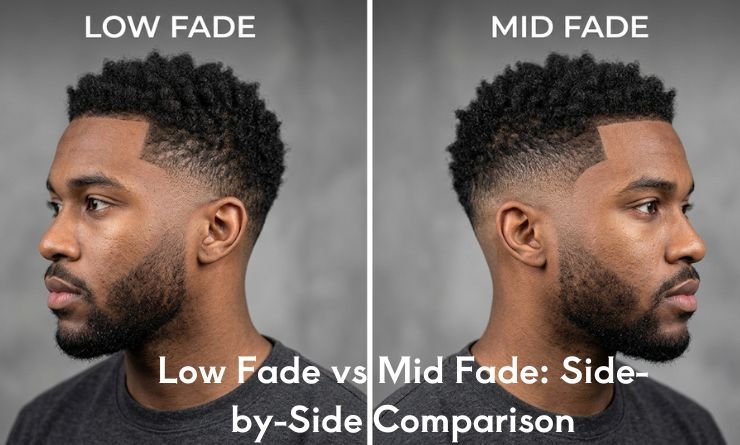
| Feature | Low Fade | Mid Fade |
|---|---|---|
| Starting point | Just above the ear | Around the temple |
| Contrast level | Subtle | Medium to high |
| Best for | Longer tops, oval faces | Most face shapes |
| Look | Conservative, classic | Modern, sharp |
| Maintenance | Low | Low to moderate |
| Barbershop difficulty | Easy | Easy |
Which Fade Suits Your Face Shape?
Round face: Go with a mid fade. It cuts the sides tighter and adds height, making the face look longer and slimmer.
Square face: Both work. A low fade keeps the strong jawline visible. A mid fade adds sharpness without being too aggressive.
Oval face: Lucky again — both fades look great. Oval faces are the most flexible for any haircut style.
Rectangular face: A low fade is better here. It keeps more hair on the sides and balances the longer face shape without adding extra height.
Diamond face: A mid fade works well. It reduces width at the sides naturally and brings focus to the top.
Which One Is Easier to Maintain?
Both fades are low maintenance day to day. The real difference shows up at the barbershop.
A low fade grows out more gracefully. Because it starts low and keeps more hair on the sides, it takes longer to look overgrown. Most guys can go 4–5 weeks before it starts looking rough.
A mid fade is sharper and more defined — which means it shows growth faster. After 3–4 weeks the line starts to blur and the fade loses its clean look. Regular trims keep it looking fresh.
Which One Looks Better With Your Haircut?
Crew cut: Both work. A low fade keeps it classic. A mid fade makes it more modern.
Textured crop: Mid fade is the better match. The contrast complements the textured top perfectly.
Quiff or pompadour: Low fade or mid fade both work depending on how dramatic you want the overall look.
Buzz cut: Mid fade adds definition to an otherwise uniform cut. Low fade keeps it very subtle and understated.
Longer styled hair: Low fade is the better choice. Too much fade with long hair on top can look unbalanced.
Exude timeless wealth with depth enhancing versus sleek flat styles reflecting elite heritage charm.
Low Fade vs Mid Fade: Which Should You Choose?
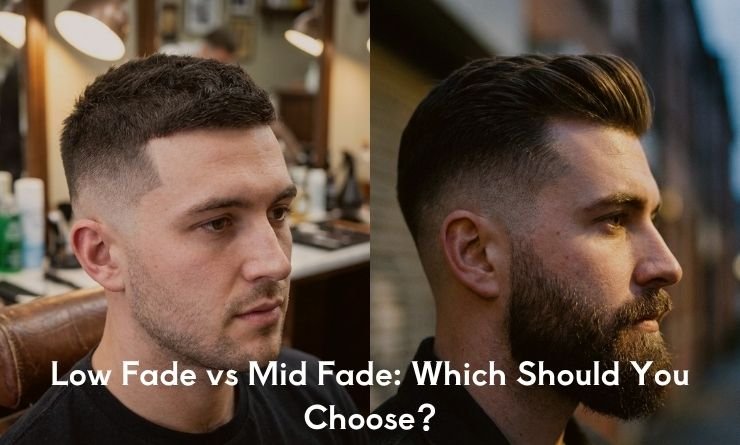
Choose a low fade if:
- You want a subtle, conservative look
- You have a longer hairstyle on top
- You prefer less contrast on the sides
- You want to go longer between trims
Choose a mid fade if:
- You want a sharper, modern look
- You have a shorter style on top
- You want more definition and contrast
- You like a bold, clean finish
Exude timeless wealth with classic military versus preppy refined styles reflecting elite heritage charm.
Final Thoughts
Low fade and mid fade are both great choices — they just serve different purposes. The low fade is subtle and classic. The mid fade is sharp and modern.
The best fade for you depends on your face shape, your hairstyle on top, and the look you’re going for. Tell your barber which one you want. Show a photo. Specify the blend style.
That’s all it takes to leave the chair looking exactly how you wanted.